
About

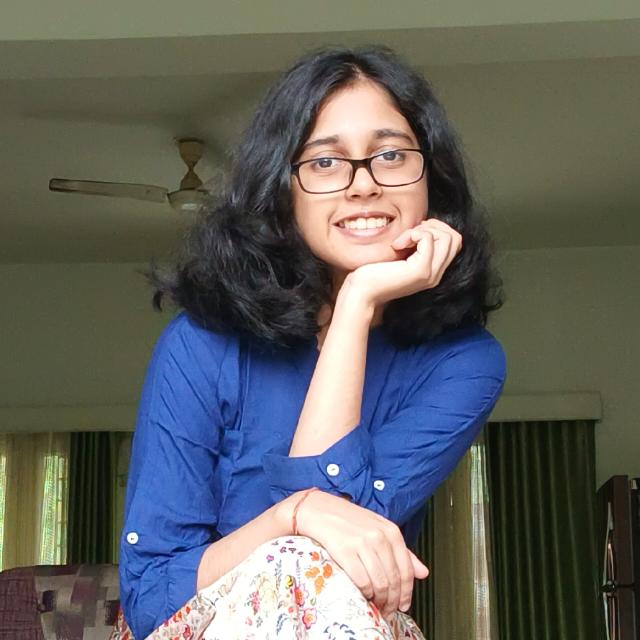
Hewo! My name is Sunaina Pati, and I am a first year undergraduate student in CMI.

I started this blog to discuss my math ideas, to share my experiences, my own notes(both school and olympiad) and many more. I would call this blog, heavily mathematics-biased. I do post a few non-math posts. Moreover, this blog is where I put a lot of problems I solved. So I post the solutions here, to verify my solution and practice proof writing. 

Also, these problems are really perfect and not heavy theory-based. The difficulty range is however quite large. In general, it's IMO P1 level or higher. 

Though there is no guarantee about when I will post, so if you are interested, then do subscribe 😄, so that you don't miss out on anything new!

Here's a little about me:

  • I would describe myself as a math enthusiast, who likes learning new theories and applying them to various problems. 
  • I am a three times IMOTC qualifier and EGMO 2023 silver medalist.  
  • My MBTI type is INTJ-T.
  • I love solving Olympiad math problems and teaching math to other kids.
  • I run a very cool math club called The Philomath club.
  • I don't have a favourite area in Olympiad mathematics, however, I tend to solve some of the geometry problems in the test, thanks to the amazing book EGMO. 
  • Apart from doing olympiad math, I usually spend my time studying school books, watching k-dramas, reading webtoons and making digital art.
  • I love listening to K-POP ( TXT, Enhypen, BTS, Seventeen, Exo, G-Idle, Kard, Mamamoo, Black Pink, New Jeans, Lessarafim, NCT, Stray Kids, Red Velvet, Eric Nam, Woostein, Woosung, Sunmi, Somi) and Indian Indies( Western Ghats and Zaeden are my favs) 


  • Total problems discussed: 330

  • Total Posts: 52

Some fun FAQs:

0. How should I use this blog?

Ans: I won't be biased. You can subscribe to this blog if you want to (you can unsubscribe whenever you want to)!

  • The content I will be sharing is probably me writing solutions to ISLs and many more Math contest problems. And maybe rate them according to me. I personally prefer walkthroughs ( And I agree it's easier to write too, but I need to practice my proof-writing too! ) 

  • You can simply binge-read my posts! It's quite fun to see me suffering

  • I am a human. I won't post only math. I will be posting non-math too. The non-math content is pretty random. Sometimes I just post cat memes or sometimes some serious talk. But I assure you, this won't be boring. 

  • If you are a high-school student who wants to do good on Boards and in the olympiads too. I understand how much pressure you must be going through, so don't worry about the school. I have made notes for a few of the chapters of Class 10, which I used for myself! They are pretty nice ( sufficient enough for scoring 95% I guess?). Read them before you read the book. After reading the notes, read the book. You are set! 

    I think you can refer to my Humanities area and Bio notes! They are actually pretty good. Rest depends on how good you can "bend and write the answers with beauty."
    You can get them on my Notes  and Problem Sets page.

  • I have a Post log page. The main motivation to make such a page was to help other people to use this blog in the best possible way! 

    The archive widget and categories could possibly help, but this page is quite systematic. Moreover, I have given a basic preview of the blog post too!

1. What's your favourite K-POP band?

Ans: Currently Tomorrow x Together. I really love them. However musically, I am really into Enhypen! 

2. What's your favourite colour?

Ans: Aquamarine and ochre. Bright yellow and pastel shades too.

3. What's your Zodiac sign?

Ans: Capricorn ( And I am a true Capricorn)

4. What's your favourite genre in music?

Ans: K-PoP, J-PoP and Indian Indies.

Lastly, I am Sunaina Pati in MSE, Jelena_ivanchic in AOPS, Sun_Prime#7400 in Discord and Sunaina Pati in Linkedin.


See y'all soon! 

Sunaina 💜

Popular posts from this blog

My experiences at EGMO, IMOTC and PROMYS experience

Yes, I know. This post should have been posted like 2 months ago. Okay okay, sorry. But yeah, I was just waiting for everything to be over and I was lazy. ( sorry ) You know, the transitioning period from high school to college is very weird. I will join CMI( Chennai Mathematical  Institue) for bsc maths and cs degree. And I am very scared. Like very very scared. No, not about making new friends and all. I don't care about that part because I know a decent amount of CMI people already.  What I am scared of is whether I will be able to handle the coursework and get good grades T_T Anyways, here's my EGMO PDC, EGMO, IMOTC and PROMYS experience. Yes, a lot of stuff. My EGMO experience is a lot and I wrote a lot of details, IMOTC and PROMYS is just a few paras. Oh to those, who don't know me or are reading for the first time. I am Sunaina Pati. I was IND2 at EGMO 2023 which was held in Slovenia. I was also invited to the IMOTC or International Mathematical Olympiad Training Cam...

Geometry ( Finally!!!)

 This is just such an unfair blog.  Like if one goes through this blog, one can notice how dominated  Algebra is!! Like 6 out of 9 blog post is Algebra dominated -_- Where as I am not a fan of Algebra, compared to other genres of Olympiad Math(as of now). And this was just injustice for Synthetic Geo. So this time , go geo!!!!!!!!!!!  These problems are randomly from A Beautiful Journey through Olympiad Geometry.  Also perhaps I will post geo after March, because I am studying combi.  Problem:  Let $ABC$ be an acute triangle where $\angle BAC = 60^{\circ}$. Prove that if the Euler’s line of $\triangle ABC$ intersects $AB$ and $AC$ at $D$ and $E$, respectively, then $\triangle ADE$ is equilateral. Solution:  Since $\angle A=60^{\circ}$ , we get $AH=2R\cos A=R=AO$. So $\angle EHA=\angle DOA.$ Also it's well known that $H$ and $O $ isogonal conjugates.$\angle OAD =\angle EAH.$ By $ASA$ congruence, we get $AE=AD.$ Hence $\triangle ADE$ is equilateral....

Just spam combo problems cause why not

This post is mainly for Rohan Bhaiya. He gave me/EGMO contestants a lot and lots of problems. Here are solutions to a very few of them.  To Rohan Bhaiya: I just wrote the sketch/proofs here cause why not :P. I did a few more extra problems so yeah.  I sort of sorted the problems into different sub-areas, but it's just better to try all of them! I did try some more combo problems outside this but I tried them in my tablet and worked there itself. So latexing was tough. Algorithms  "Just find the algorithm" they said and they died.  References:  Algorithms Pset by Abhay Bestrapalli Algorithms by Cody Johnson Problem1: Suppose the positive integer $n$ is odd. First Al writes the numbers $1, 2,\dots, 2n$ on the blackboard. Then he picks any two numbers $a, b$ erases them, and writes, instead, $|a - b|$. Prove that an odd number will remain at the end.  Proof: Well, we go $\mod 2$. Note that $$|a-b|\equiv a+b\mod 2\implies \text{ the final number is }1+2+\dots ...

IMO Shortlist 2021 C1

 I am planning to do at least one ISL every day so that I do not lose my Olympiad touch (and also they are fun to think about!). Today, I tried the 2021 IMO shortlist C1.  (2021 ISL C1) Let $S$ be an infinite set of positive integers, such that there exist four pairwise distinct $a,b,c,d \in S$ with $\gcd(a,b) \neq \gcd(c,d)$. Prove that there exist three pairwise distinct $x,y,z \in S$ such that $\gcd(x,y)=\gcd(y,z) \neq \gcd(z,x)$. Suppose not. Then any $3$ elements $x,y,z\in S$ will be $(x,y)=(y,z)=(x,z)$ or $(x,y)\ne (y,z)\ne (x,z)$. There exists an infinite set $T$ such that $\forall x,y\in T,(x,y)=d,$ where $d$ is constant. Fix a random element $a$. Note that $(x,a)|a$. So $(x,a)\le a$.Since there are infinite elements and finite many possibilities for the gcd (atmost $a$). So $\exists$ set $T$ which is infinite such that $\forall b_1,b_2\in T$ $$(a,b_1)=(a,b_2)=d.$$ Note that if $(b_1,b_2)\ne d$ then we get a contradiction as we get a set satisfying the proble...

Number Theory Revise part 1

I thought to revise David Burton and try out some problems which I didn't do. It's been almost 2 years since I touched that book so let's see! Also, this set of problems/notes is quite weird since it's actually a memory lane. You will get to know on your own! I started with proving a problem, remembered another problem and then another and so on! It was quite fun cause all these questions were the ones I really wanted to solve! And this is part1 or else the post would be too long. Problem1: Prove that for $n\ge 1$  $$\binom{n}{r}<\binom{n}{r+1}$$ iff $0\le r\le \frac{n-1}{2}$ Proof: We show that $\binom{n}{r}<\binom{n}{r+1}$ for $0\le r\le \frac{n-1}{2}$ and use the fact that $$\binom{n}{n-r}=\binom{n}{r}$$ Note that $\binom{n}{r}= \frac{n!}{r!(n-r)!}, \binom{n}{r+1}=\frac{n!}{(r+1)!(n-r-1)!}$  Comparing, it's enough to show that $$\frac{1}{n-r}<\frac{1}{r+1}\text{ or show } n-r>r+1$$ which is true as $0\le r\le \frac{n-1}{2}$ Problem2: Show that the exp...

Problems with meeting people!

Yeah, I did some problems and here are a few of them! I hope you guys try them! Putnam, 2018 B3 Find all positive integers $n < 10^{100}$ for which simultaneously $n$ divides $2^n$, $n-1$ divides $2^n - 1$, and $n-2$ divides $2^n - 2$. Proof We have $$n|2^n\implies n=2^a\implies 2^a-1|2^n-1\implies a|n\implies a=2^b$$ $$\implies 2^{2^b}-2|2^{2^a}-2\implies 2^b-1|2^a-1\implies b|a\implies b=2^c.$$ Then simply bounding. USAMO 1987 Determine all solutions in non-zero integers $a$ and $b$ of the equation $$(a^2+b)(a+b^2) = (a-b)^3.$$ Proof We get $$ 2b^2+(a^2-3a)b+(a+3a^2)=0\implies b = \frac{3a-a^2\pm\sqrt{a^4-6a^3-15a^2-8a}}{4}$$ $$\implies a^4-6a^3-15a^2-8a=a(a-8)(a+1)^2\text{ a perfect square}$$ $$\implies a(a-8)=k^2\implies a^2-8a-k^2=0\implies \implies a=\frac{8\pm\sqrt{64+4k^2}}{2}=4\pm\sqrt{16+k^2}. $$ $$ 16+k^2=m^2\implies (m-k)(m+k)=16.$$ Now just bash. USAMO 1988 Suppose that the set $\{1,2,\cdots, 1998\}$ has been partitioned into disjoint pairs $\{a_i,b_i\}$ ($1...

Orders and Primitive roots

 Theory  We know what Fermat's little theorem states. If $p$ is a prime number, then for any integer $a$, the number $a^p − a$ is an integer multiple of $p$. In the notation of modular arithmetic, this is expressed as \[a^{p}\equiv a{\pmod {p}}.\] So, essentially, for every $(a,m)=1$, ${a}^{\phi (m)}\equiv 1 \pmod {m}$. But $\phi (m)$ isn't necessarily the smallest exponent. For example, we know $4^{12}\equiv 1\mod 13$ but so is $4^6$. So, we care about the "smallest" exponent $d$ such that $a^d\equiv 1\mod m$ given $(a,m)=1$.  Orders Given a prime $p$, the order of an integer $a$ modulo $p$, $p\nmid a$, is the smallest positive integer $d$, such that $a^d \equiv 1 \pmod p$. This is denoted $\text{ord}_p(a) = d$. If $p$ is a primes and $p\nmid a$, let $d$ be order of $a$ mod $p$. Then $a^n\equiv 1\pmod p\implies d|n$. Let $n=pd+r, r\ll d$. Which implies $a^r\equiv 1\pmod p.$ But $d$ is the smallest natural number. So $r=0$. So $d|n$. Show that $n$ divid...

Some Geometry Problems for everyone to try!

 These problems are INMO~ish level. So trying this would be a good practice for INMO!  Let $ABCD$ be a quadrilateral. Let $M,N,P,Q$ be the midpoints of sides $AB,BC,CD,DA$. Prove that $MNPQ$ is a parallelogram. Consider $\Delta ABD$ and $\Delta BDC$ .Note that $NP||BD||MQ$. Similarly, $NM||AC||PQ$. Hence the parallelogram. In $\Delta ABC$, $\angle A$ be right. Let $D$ be the foot of the altitude from $A$ onto $BC$. Prove that $AD^2=BD\cdot CD$. Note that $\Delta ADB\sim \Delta CDA$. So by similarity, we have $$\frac{AD}{BD}=\frac{CD}{AD}.$$ In $\Delta ABC$, $\angle A$ be right. Let $D$ be the foot of the altitude from $A$ onto $BC$. Prove that $AD^2=BD\cdot CD$. Let $D\in CA$, such that $AD = AB$.Note that $BD||AS$. So by the Thales’ Proportionality Theorem, we are done! Given $\Delta ABC$, construct equilateral triangles $\Delta BCD,\Delta CAE,\Delta ABF$ outside of $\Delta ABC$. Prove that $AD=BE=CF$. This is just congruence. N...

IMO 2023 P2

IMO 2023 P2 Well, IMO 2023 Day 1 problems are out and I thought of trying the geometry problem which was P2.  Problem: Let $ABC$ be an acute-angled triangle with $AB < AC$. Let $\Omega$ be the circumcircle of $ABC$. Let $S$ be the midpoint of the arc $CB$ of $\Omega$ containing $A$. The perpendicular from $A$ to $BC$ meets $BS$ at $D$ and meets $\Omega$ again at $E \neq A$. The line through $D$ parallel to $BC$ meets line $BE$ at $L$. Denote the circumcircle of triangle $BDL$ by $\omega$. Let $\omega$ meet $\Omega$ again at $P \neq B$. Prove that the line tangent to $\omega$ at $P$ meets line $BS$ on the internal angle bisector of $\angle BAC$. Well, here's my proof, but I would rather call this my rough work tbh. There are comments in the end! Proof Define $A'$ as the antipode of $A$. And redefine $P=A'D\cap (ABC)$. Define $L=SP\cap (PDB)$.  Claim1: $L-B-E$ collinear Proof: Note that $$\angle SCA=\angle SCB-\angle ACB=90-A/2-C.$$ So $$\angle SPA=90-A/2-C\implies \ang...

Problems I did this week [Jan8-Jan14]

Yeyy!! I am being so consistent with my posts~~ Here are a few problems I did the past week and yeah INMO going to happen soon :) All the best to everyone who is writing!  I wont be trying any new problems and will simply revise stuffs :) Some problems here are hard. Try them yourself and yeah~~Solutions (with sources) are given at the end! Problems discussed in the blog post Problem1: Let $ABC$ be a triangle whose incircle $\omega$ touches sides $BC, CA, AB$ at $D,E,F$ respectively. Let $H$ be the orthocenter of $DEF$ and let altitude $DH$ intersect $\omega$ again at $P$ and $EF$ intersect $BC$ at $L$. Let the circumcircle of $BPC$ intersect $\omega$ again at $X$. Prove that points $L,D,H,X$ are concyclic. Problem 2: Let $ ABCD$ be a convex quadrangle, $ P$ the intersection of lines $ AB$ and $ CD$, $ Q$ the intersection of lines $ AD$ and $ BC$ and $ O$ the intersection of diagonals $ AC$ and $ BD$. Show that if $ \angle POQ= 90^\circ$ then $ PO$ is the bisector of $ \angle AOD$ ...